
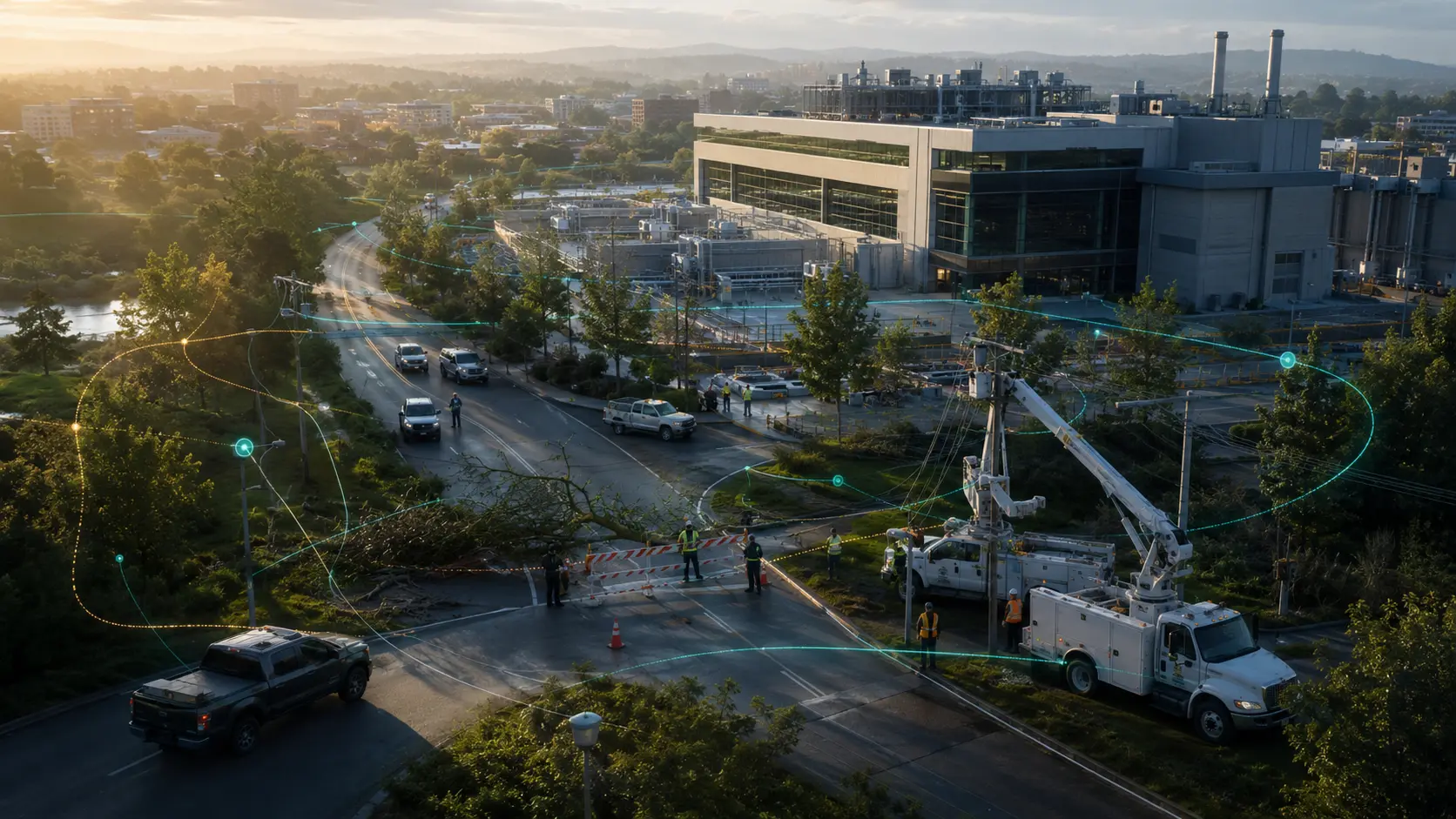

Harbinger for Civilian Operations

Adaptive autonomy for civilian operations.

The operation keeps moving. Harbinger keeps reallocating.

Harbinger applies OnSeen’s agentic Resource Allocation AI to civilian operations. It recognizes when changing needs, competing priorities, and limited resources make the current allocation unworkable. It develops alternative responses and determines how available resources should be used next.

Harbinger autonomously puts that allocation into motion, monitors execution, and changes the affected work as conditions evolve.

One city.
Three competing demands.

Illustrative civilian operation

A water main ruptures during the morning commute. The closest repair crew is committed to another urgent job, the required excavator is at a different site, and closing the road would disrupt a major transit route.

Harbinger recognizes that the current allocation cannot handle the disruption. It reasons across service impact, crew capabilities, equipment availability, and existing commitments to develop an executable response.

Harbinger autonomously reallocates the crew and equipment, resequences lower-priority work, and updates the affected routes, schedules, and notifications. As crews report progress or encounter another constraint, it adjusts the response and the work that depends on it.

From rupture to coordinated response.
Disruption

Water main ruptures

Morning commute

Competing demands

Repair crew

Committed to another urgent job

Excavator

At a different site

Transit route

Affected by the road closure

Agentic Resource Allocation AI

Harbinger

Assess the impact. Develop and test responses.
Determine an executable allocation.

Reassign the crew

Resequence lower-priority work

Move the equipment

Bring the excavator to the rupture

Reroute transit

Update schedules and notifications

Execution feedback

Monitor progress. Adapt the response.

Field results return to Harbinger for reassessment.

Managers don’t reconstruct the operation by hand.
Harbinger keeps the work aligned.

Resource decisions become coordinated action.

Harbinger connects the reasoning behind an allocation to the people and systems that carry it out. A change in one part of the operation prompts reassessment of the work it affects.

OnSeen green Harbinger orb

Executable resource allocation

OnSeen’s agentic Resource Allocation AI develops alternative responses and tests them against objectives, priorities, constraints, and available resources. It determines an executable allocation of People, Places, Things, Time and Money, accounting for dependencies and competing demands.

Adaptive execution

Harbinger turns the allocation into assignments, schedules, notifications, and resource movements across connected systems and field teams. It monitors results and autonomously revises the affected work while the operation continues.

Changing conditions.
Coordinated responses.

Harbinger takes initiative when needs and available capacity fall out of sync. It identifies the consequences, determines the next allocation, and keeps connected teams working toward the same objective.

01

Infrastructure and Facilities

A failed asset triggers a coordinated response.

Harbinger identifies how equipment failures, service disruptions, and changing priorities affect maintenance work and service delivery. It autonomously reallocates crews and equipment, adjusts access and timing, and revises dependent assignments to keep the wider operation moving.

02

Emergency and Field Operations

The response changes while crews are already moving.

Harbinger develops responses around incident needs, responder capabilities, and available resources. It allocates teams and equipment, coordinates assignments and routes, and adapts the response as field reports reveal what the situation requires next.

03

Logistics and Transportation

A disruption becomes a new route, assignment, and schedule.

Harbinger recognizes when a route closure, unavailable vehicle, or capacity constraint breaks the current allocation. It autonomously reroutes vehicles, changes assignments, and reconciles the affected schedules and commitments so one disruption does not leave the rest of the operation working from an outdated plan.

04

Health Care

Changing demand. Coordinated operational resources.

Harbinger reasons across patient demand and the availability of clinicians, facilities, and equipment. It coordinates operational resources with appointments and transportation, then reallocates capacity and updates affected assignments as needs change.

05

Data Centers

Capacity changes. Harbinger rebuilds the operating plan.

Harbinger identifies when power, cooling, compute, or maintenance constraints make the current allocation unworkable. It develops an executable alternative, reallocates capacity and technicians, and resequences affected work as operating conditions change.

06

Manufacturing

One constraint changes. Harbinger resynchronizes production.

Harbinger reasons across production demand, workforce availability, materials, and equipment capacity. When a shortage, outage, or priority change disrupts the plan, it autonomously reallocates work, resequences production, and updates the assignments that depend on it.

One connected operation.
More from the resources available.

Harbinger coordinates people, assets, and tasks as one connected system. It keeps resource decisions and execution aligned as conditions change, expanding what the organization accomplishes with the capacity it has.

Talk with OnSeen