
The Current Reality
Currently, management of financial accounts for Individuals with developmental disabilities by DD providers and payees is typically a manual, inefficient, error-prone and administratively complex process. Manual management processes for financial accounts of Individuals require meticulous record-keeping, strict separation of funds, and compliance with benefit regulations (such as SSI/Medicaid). It typically involves using paper ledgers, cash envelopes, and physical receipt storage to track personal allowance funds, often overseen by a representative payee or provider staff member.
These manual management and administrative processes often consist of the following components:
1. Documentation and Record-Keeping
- Individualized Ledgers: Separate, hand-kept ledgers must be maintained for each Individual, documenting all deposits, withdrawals, and the current balance.
- Receipt Tracking: Receipts are required for purchases, particularly for items over a certain amount, which must correspond to ledger entries. Physical receipts are usually kept in envelopes, boxes or folders for later reviews or audits.
- Initialing Transactions: Individuals are often encouraged to initial entries on residential ledgers to confirm transactions, unless their Personal Expenditure Plan indicates they cannot understand the process.
- Physical Filing: A secure, physical file is usually maintained for each person, holding receipts, bank statements, and, in cases of foster care, detailed records of income and disbursements.
2. Cash and Account Management
- Personal Allowance Handling: Payee staff or caregivers often manage a personal needs allowance for day-to-day spending, which is kept separate from other room and board payments.
- Cash on Hand: Cash is frequently stored in a secure location (e.g., a safe) at the residence, with manual processes to ensure the ledger balance matches the cash on hand.
- Separation of Funds: Funds should be kept separate and never commingled with agency or staff funds. If a bank account is used, it should be in the individual’s name.
3. Budgeting and Planning
- Money Management Assessment: An annual assessment is generally conducted to determine the individual’s capacity to manage funds and the frequency/amount of money they can handle.
- Personal Expenditure Plan: A written plan dictates how funds are used, covering essentials like rent, food, and personal items, as well as recreational activities.
4. Monitoring and Compliance
- Audits: Providers or payees are required to perform regular audits to ensure compliance with financial regulations.
- Quarterly Reporting: Ledgers are often sent to a representative payee on a quarterly basis to review transactions.
- Reconciliation: Retailer rewards, coupons, or gift cards earned by the Individual must be recorded in the ledger and used only for that Individual.
Automating Financial Account Management Is Imperative
Unfortunately, manual financial account management processes lead to many challenges for both Individuals and their families, as well as, for their providers and payees. Automating these processes is quickly transitioning from a nice option for early adopters to an absolute requirement for virtually every provider or payee supporting Individuals with developmental disabilities. The best approach to management of Individual financial accounts is accomplished by streamlining and automating these arcane, manual, spreadsheet-based and administratively clumsy processes.
Automating these processes for Individuals with DD is crucial to them for many reasons, including to:
- protect them against financial exploitation,
- ensure their long-term financial security,
- maintain their eligibility for benefits like SSI and Medicaid, and
- promote their financial independence by delivering transparency to their financial account transactions and statements.
From the DD payee and provider perspective, automating financial account management for Individuals has many benefits, as well, including:
- improves administrative efficiency and reducing associated cost,
- reduces both fraud and unintentional errors,
- minimizes associated fines and penalties, and
- increases the speed and quality of their financial account management services.
OnSeen Provides a “Best-In-Class” Solution for Financial Account Management
The LiveCare Consumer Financial Account Management (CFAM) Module, developed by OnSeen, is an intelligent, automated, full-service solution to manage financial accounts on behalf of Individuals. It was developed and initially launched in 2021 and has been continually enhanced based on the inputs of hundreds of users across numerous providers, spanning multiple states.
The CFAM Module allows providers and payees to manage Individual’s financial accounts (e.g. petty cash, gift cards, EBT cards, savings or checking accounts, etc) in a highly efficient, real-time, paperless and compliant manner, ensuring proper fiduciary oversight of Individual accounts. Specifically, the CFAM Module delivers the following:
- Reduced Financial Admin Errors, UIs & MUIs through auto-identification and notification of admin errors and suspicious transactions.
- Improved Consumer, Family Member & Guardian Convenience with real-time access and visibility into their Individuals’ accounts, transaction details and statements.
- Increased Provider/Payee Efficiency & Reduced Administrative Cost by automating inefficient transaction recording, receipt capture, on-hand cash management and month end processes.
- Fast, Accurate Month-End Reconciliation & Financial Packet Prep by automating and digitizing monthly Consumer financial package preparation, reconciliation and approval processes.
- Increased Process Discipline & Fiduciary Control from automated, multi-tier approval workflow that allows supervisors and managers to quickly review and approve transactions and monthly statements.
The following chart depicts the major components of the LiveCare CFAM Module:
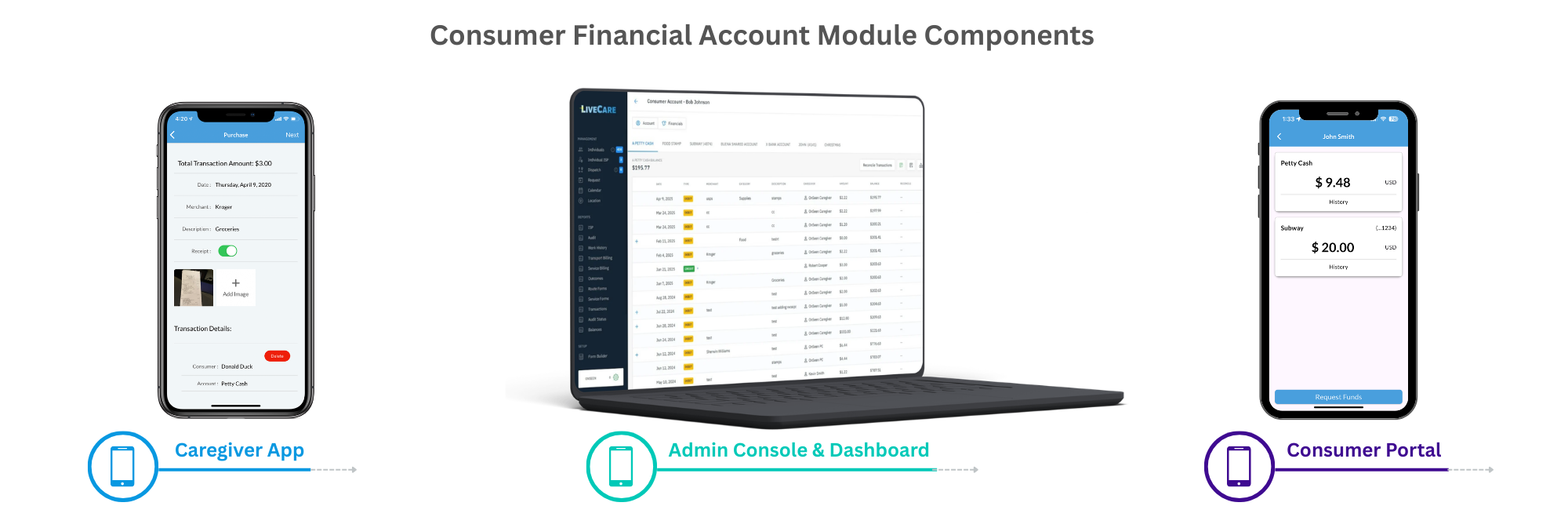
Through the LiveCare Caregiver App, DSPs, payee staff and caregivers can easily and electronically:
- Record transactions
- Take pictures of receipts
- Capture e-Signatures on withdrawals and other transactions
- Perform periodic e-Ledger to physical cash balance audits
With the LiveCare Admin Module, provider and payee managers, supervisors and admins have continual, real-time access and visibility to:
- Oversee all Consumer financial accounts
- Receive notifications of errors, balance discrepancies, suspicious transactions
- Perform monthly account reconciliation
- Prepare monthly financial packets for each Individual
- Manage monthly financial packet review and approval
The LiveCare Consumer App provides Individuals, approved family members and/or guardians with:
- Real-time visibility of Individuals’ financial account activities
- Ability to request funds from provider or payee
- Ability to monitor transactions and balances for all their financial accounts
The following chart represents a case study performed on the impact of the LiveCare CFAM across over a thousand financial accounts:


In conclusion, it is both instinctive, and proven through case studies, that replacing a largely manual, hard copy, spreadsheet financial account management process with the LiveCare CFAM Module generates benefits for all participants in the process, Individuals, families, providers and payees. And perhaps most importantly, using the CFAM Module empowers Individuals and helps bridge the gap in financial inclusion.
Rich Johnson, CEO of a large provider headquartered in Dublin, Ohio summed it up as follows: “The LiveCare Consumer Financial Account Module has transformed how we manage Financial Accounts for over 800 Individuals. Our old paper ledgers, wrinkled hardcopy receipts and manual monthly reconciliation and paper-based financial packet preparation are gone. And so are nearly all errors and associated UIs and MUIs.”
For more information on the LiveCare Consumer Financial Account Management Module, please click this Contact Us link.